Studio One pioneered the drag-and-drop workflow that continues to be a guiding principle in our design philosophy. Audio loops, virtual instruments, plug-in effects and even presets can all be dragged into your session from Studio One’s innovative Browser. Copy FX Chains from one channel to another simply by dragging and dropping.
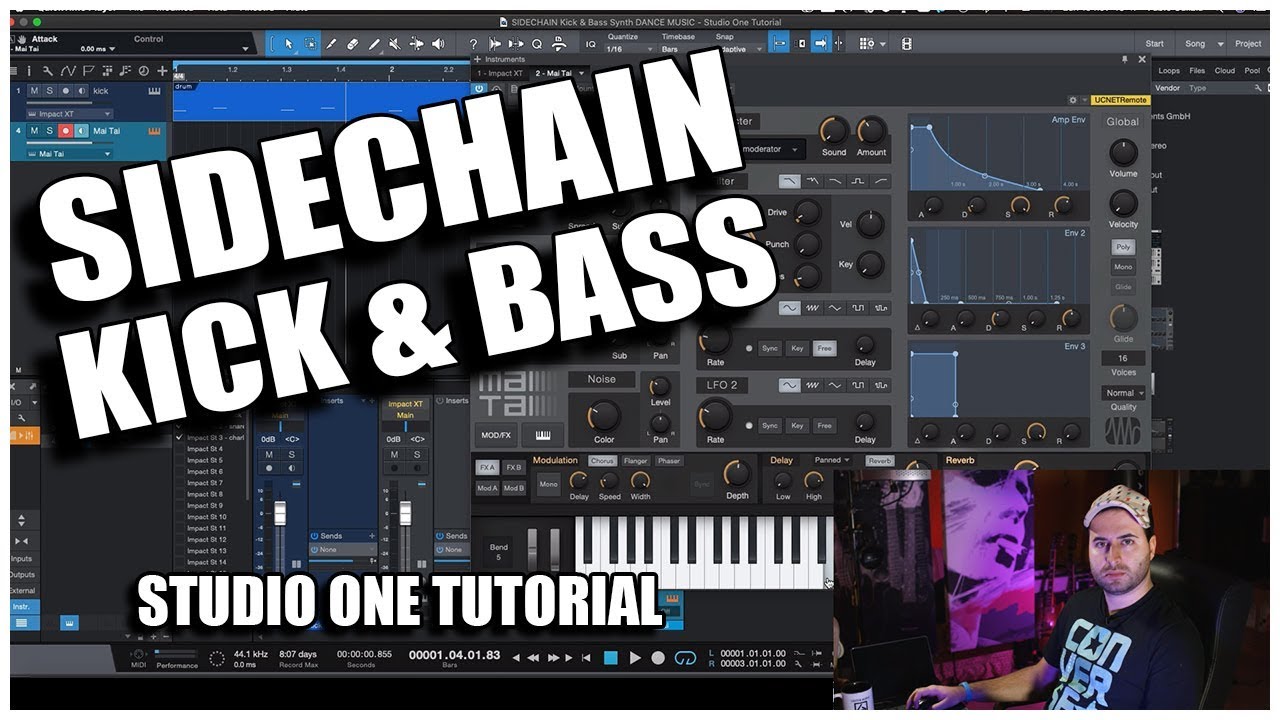
- Studio One makes it super easy. WHAT is Side Chaining and WHY do you want to use it? Watch the vid and I'll answer both questions. Studio One makes it super easy.
- Studio One pioneered the drag-and-drop workflow that continues to be a guiding principle in our design philosophy. Audio loops, virtual instruments, plug-in effects and even presets can all be dragged into your session from Studio One’s innovative Browser. Copy FX Chains from one channel to another simply by dragging and dropping.
Sidechain Compression Studio One 4
| I know how to sidechain into a compressor. But how can I selectively sidechain one frequency band inside an eQ? I do that all the time in FL, where I filter only the low end on a bass using a sidechain from a kick going to the bass EQ, that way I don't have to sidechain the whole spectrum of an instrument which is quite handy as is cleaner. TIA OS: Win10 x64 - Machine: i7 3770k @ 4.6ghz (on water) - 32gb RAM - 3x 256GB SSD Geforce 660gtx - 3x display @1920x1080 - Presonus Firestudio Project - Monitor Station V2 - Presonus Dual Bluetube v2 - Faderport - TEC Breath controller - 4x Launchpad Pro - Ernie Ball VPJR volume pedal - Keystation 88MKII - KORG PadKontrol - KORG Nanocontrol 2 - 10x AudioCubes - Manhattan MondoHub 32 ports (4amp total) - Bunch of mics - AKG701 and AKG712pro (mixing) and Extreme Isolation (recording) headphones, 9 guitars 1 lapguitar- 2 basses, Zoom G5 Guitar pedal board, A3 and MS100BT Pedals. |

| Unkess you have a plugin that has separate sidechain trigger inputs for each band, I don't think you can do that. BUT, you can set up as many trigger source tracks as you like, each with extreme eq and filtering on them, and then use those trigger tracks any way you want. As far as sidechain input operation, most of my plugins play pretty nice together. I just checked to see if my Eventide Ultrachannel has full side chain operation and it doesn't. The NI stuff I checked does. The frequency split compression thing you want to do is very doable, but the easiest way I can think of would be to duplicate your tracks, and use a 'lo/hi' split configuration, and send the trigger only to the low band track. Every DAW has its pros and cons. I know 'Reason' pretty well and miss some of the stuff I used to do there. I am sure you can find a way to duplicate this particular behaviour in StudioOne. You could even save some channel plugin sets to make this a 5 second operation after you have it tweaked. i7 3770,ASUS P8Z68-V-LE RME Multiface x2,RME ADI2,Lucid 2496. Casio PX-3,Yamaha V50,Korg 05,Roland SH-01,Korg Nanopad2,Behringer BCF,BCR2000(studio). i7 4770, Asus Z87-C, M-Audio delta66,RME ADI2,Vox TonelabLE (spdif input), A&HZED12FX, M-Audio Keystation61ES (home). Soundworkshop Series30(rackmounted in groups of 8), Dynaudio BM15 speakers. Win10 64,S1Pro,Soundforge10, CD Arch5,Reason10,Recycle, Waves, Drumcore 3, Korg legacy digital and analogue, Arturia Vintage Collection, NI Komplete10,Alicia's Keys,Vintage compressors,Premium tube series. https://soundcloud.com/andrew-emery |
| The Studio One ProEQ plugin has a sidechain input to compare two signals. I am Sir Melvis Bacon, Knight of BaconHam Palace. Studio One 2 Pro 3.3.x (64 bit). MacBook Pro 13'. OS X Sierra version 10.12.3. RM16AI and CS18AI connected in Stagebox mode via MOTU AVB Switch. StudioLive 328AI (x2); AudioBox 22 VSL; BlueTube DP V2; FaderPort; Monitor Station; RC 500; Temblor T10. To add your software and hardware specs to your signature to make it easier for us to help you, click HERE. My Website |
Who is online

Users browsing this forum: Tzman999 and 38 guests
You’re probably aware that several Studio One audio processors offer sidechaining—Compressor, Autofilter, Gate, Expander, and Channel Strip. However, both the Spectrum Meter and the Pro EQ spectrum meter also have sidechain inputs, which can be very handy. Let’s look at Pro EQ sidechaining first.
When you enable sidechaining, you can feed another track’s output into the Pro EQ’s spectrum analyzer, while still allowing the Pro EQ to modify the track into which it’s inserted. When sidechained, the Spectrum mode switches to FFT curve (the Third Octave and Waterfall options aren’t available). The blue line indicates the level of the signal going through the Pro EQ, while the violet line represents the sidechain signal.
As a practical example of why this is useful, the screen shot shows two drum loops from different drum loop libraries that are used in the same song. The loop feeding the sidechain loop has the desired tonal qualities, so the loop going through the EQ is being matched as closely as possible to the sidechained loop (as shown by a curve that applies more high end, and a slight midrange bump).
Another example would be when overdubbing a vocal at a later session than the original vocal. The vocalist might be off-axis or further away from the mic, which would cause a slight frequency response change. Again, the Pro EQ’s spectrum meter can help point out any differences by comparing the frequency response of the original vocal to the overdub’s response.
Kickstart Sidechain Plugin
The Spectrum Meter
Waves Vocal Rider Sidechain

Sidechaining with the Spectrum Meter provides somewhat different capabilities compared to the Pro EQ’s spectrum analyzer.
With sidechain enabled, the top view shows the spectrum of the track into which you’ve inserted the Spectrum Meter. The lower view shows the spectrum of the track feeding the sidechain. When sidechained, all the Spectrum Meter analysis modes are available except for Waterfall and Sonogram.
While useful for comparing individual tracks (as with the Pro EQ spectrum meter), another application is to help identify frequency ranges in a mix that sound overly prominent. Insert the Spectrum Meter in the master bus, and you’ll be able to see if a specific frequency range that sounds more prominent actually is more prominent (in the screen shot, the upper spectrum shows a bump around 600 Hz in the master bus). Now you can send individual tracks that may be causing an anomaly into the Spectrum Metre’s sidechain input to determine which one(s) are contributing the most energy in this region. In the lower part of the screen shot, the culprit turned out to be a guitar part with a wah that emphasized a particular frequency. Cutting the guitar EQ just a little bit around 600 Hz helped even out the mix’s overall sound.
Of course, the primary way to do EQ matching is by ear. However, taking advantage of Studio One’s analysis tools can help speed up the process by identifying specific areas that may need work, after which you can then do any needed tweaking based on what you hear. Although “mixing with your eyes” isn’t the best way to mix, supplementing what you hear with what you see can expedite the mixing process, and help you learn to correlate specific frequencies with what you hear—and there’s nothing wrong with that.