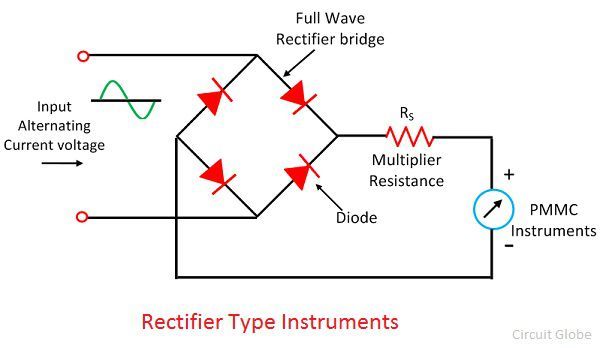
The voltmeter for alternating voltage measurement may employ a full wave bridge rectifier or a half wave rectifier with a shunt resistance across the ammeter. In either case the current that flows through the meter is the rectified alternating current. Efficiency of Half Wave Rectifier. Rectifier efficiency (ɳ) is the ratio of output DC power to the input AC power, the formula goes like: ɳ = (P dc /P ac) The efficiency of HWR is 40.6% (ɳ max = 40.6%) RMS value of Half Wave Rectifier. To find the rms value of the half-wave rectifier, we need to calculate the current across the load. The circuit generally employed in rectifier type of ammeters is explained as follows. It uses two diodes D1 and D2. They work as full wave rectifier. The moving coil is connected in such a way that it carries only half of the rectified current. Half Wave Rectifier Mains power supply is applied at the primary of the step-down transformer. All the positive half cycles of the stepped down ac supply pass through the diode and all the negative half cycles get eliminated.
In Half Wave Rectifier, when the AC supply is applied at the input, a positive half cycle appears across the load, whereas the negative half cycle is suppressed. This can be done by using the semiconductor PN junction diode. The diode allows the current to flow only in one direction. Thus, converts the AC voltage into DC voltage.
Circuit Diagram of Half Wave Rectifier
In half-wave rectification, only one crystal diode is used. It is connected in the circuit as shown below.
The AC supply to be rectified is generally given through a transformer. The transformer is used to step down or step up the main supply voltage as per the requirement. It also isolates the rectifier from power lines and thus reduces the risk of electric shock.

Operation of Half Wave Rectifier
When AC supply is switched ON the alternating voltage (Vin) shown in the figure below appears across the terminal AB at the secondary winding.
During the positive half cycle, terminal A is positive with respect to B and the crystal diode is forward biased. Therefore, it conducts and current flows through the load resistor RL. This current varies in magnitude as shown in the wave diagram shown below.
Thus, a positive half cycle of the output voltage (Vout = iRL) appears across the load resistor RL shown in the figure below.
Peak Inverse Voltage
During the negative half-cycle when the diode is reverse biased the maximum value of the voltage coming across the diode is called the peak inverse voltage. As the current flows through the load resistor RL, only in one direction, i.e., from M to L. Hence, a DC output is obtained across RL, which is pulsating in nature.
Disadvantages of the Half Wave Rectifier
The disadvantages of the half-wave rectifier are as follows:
- The output is low because the AC supply delivers power only half of the time.
- The output contains more alternating component (ripples). Therefore, it needs a heavy filter circuit to smooth out the output.
Full Wave Rectifier
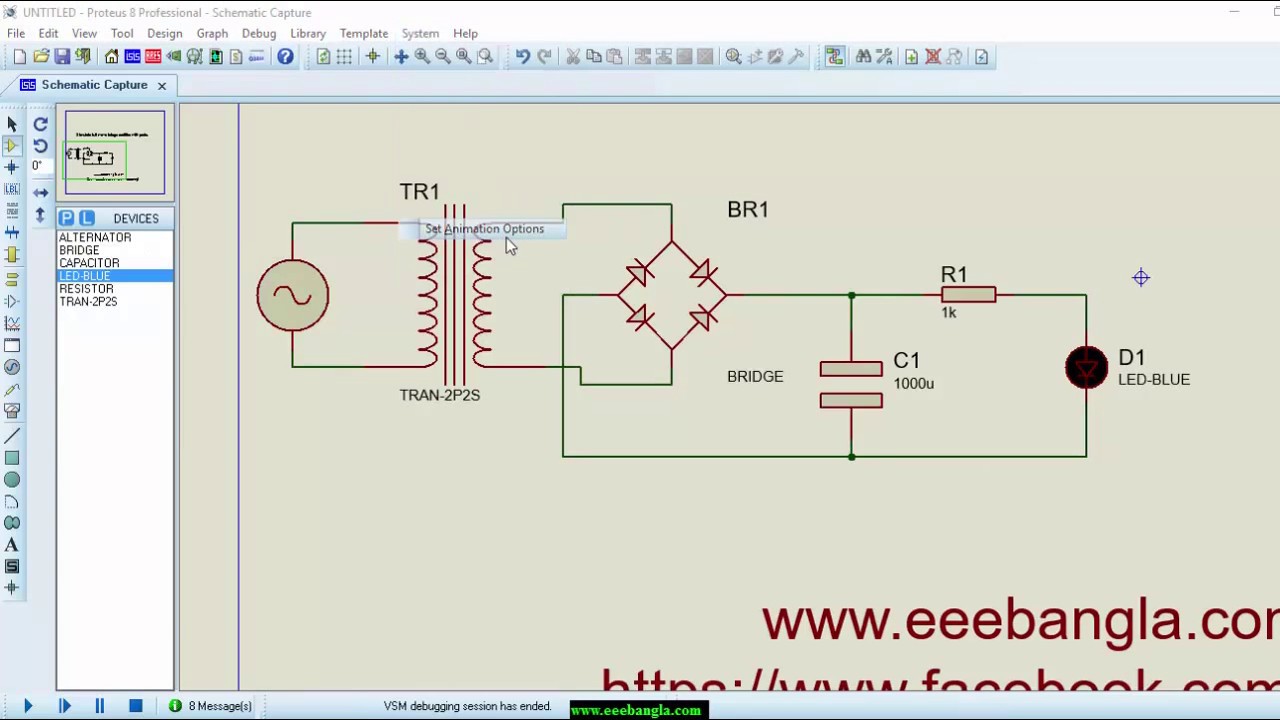
In Full Wave Rectification, when the AC supply is applied at the input, during both the half-cycles (i.e., positive as well as negative) current flows through the load in the same direction. This can be achieved by using two crystal diodes. The two diodes conduct the current alternately.
To obtain the same direction of flow of current in the load resistors RL during positive as well as the negative half cycle of input, the two circuits are used. They are named as follows:-
To have detailed explanation on the two types of full wave rectifiers follow the links given above.
Related terms:
Definition: Half wave rectifier is that in which the half cycle of AC voltage gets converted into pulsating DC voltage. The remaining half cycle of AC is suppressed by rectifier circuit or the output DC current for remaining half cycle is zero.
Circuit Diagram of Half Wave Rectifier
The AC input signal is first passed through transformer because the AC signal is generally supplied in high voltage because it is economical to provide AC at high voltage. The transformer present in half wave rectifier is step down transformer which converts the high voltage AC into low voltage DC.
The transformer is followed by a diode and a load resistor. The output current varies with the magnitude of the load resistor.
Working of Rectifier
When the high voltage AC passes from a step-down transformer, it gets converted into low voltage AC.
When the positive half cycle of low voltage AC passes from the diode, it makes the diode forward biased. This happens because the positive signal strikes the P-terminal of the diode and it makes the diode forward biased. Thus, when positive half of AC signal passes the diodes becomes a short circuit. Thus, the current passes through the load resistor, and the voltage drop can be seen across the load resistor.
When the negative half cycle of AC Signal passes through the step-down transformer then due to the phenomenon of mutual inductance, it converts it into low voltage AC. After that, it passes through the diode. When this negative half is passed through the diode, the p-terminal of the diode becomes negative with respect to n-terminal. Thus, the diodes become an open circuit. And the output current across the load becomes zero due to which output voltage also becomes zero.
Thus, during the positive half of AC, the output DC voltage is generated across a load and during the negative half of AC the rectifier switches to OFF state. In this way, the negative half cycle of the signal is suppressed in half way rectifier. It utilizes only half cycle of AC. Thus, it is called half-wave rectifier.
Analysis of Half-Wave Rectifier
- Peak Inverse Voltage: The maximum voltage that the diode can bear in reverse biased mode is called its peak inverse voltage. It is a crucial factor to be considered while designing rectifier system.
- Peak Current: The maximum current that the diode can withstand in reverse biased condition is called peak current of the diode.
- DC Output Current and DC output voltage: The average value or DC value of the output current and DC output voltage across the load resistor can be given by the following equation below.
- Form Factor and Peak factor: The form factor of half wave rectifier is given by the ratio of RMS value of current and the average value of current.
The peak factor is defined as the ratio between the peak value of current to RMS value of current.
- Output frequency: The output frequency of the rectifier is same as the frequency of the input signal.
fout = fin
- Rectification efficiency: The rectification efficiency of the rectifier is the ratio of the DC output power to the AC input power.
The value of RF is small. Thus, it can be neglected. Therefore, the rectifcation efficiency will be 0.406. In terms of percentage, it can be written as 40.6%. Thus, 40.6% is considered as the maximum possible efficiency of half wave rectifier.
Ac Voltmeter Using Half Wave Rectifier Circuit
Advantages of Half Wave Rectifier
- Economical: It is low in cost.
- Simple Circuitry: The circuit of half wave rectifier is simple to design.
Disadvantages of Half Wave Rectifier
- Low rectification Efficiency: The rectification efficiency of Half wave rectifier is quite low, i.e. 40.6%. The main reason behind this is power delivered by the circuit of half wave rectifier is only for the duration of positive half of AC cycle.
- High Ripple factor: Ripple factor is given by the ratio of the value of AC current present in the output current of the rectifier and the output dc current of the rectifier. The ripple factor in the case of half wave rectifier is quite high which is undesirable.
- Magnetising Current and hysteresis loss: The magnetizing current and hysteresis losses occur due to DC saturation of transformer core. Due to this magnetizing current harmonics are generated, and it is undesirable for the smooth operation of half wave rectifier.

Half Wave rectifiers convert only half wave of AC either positive or negative half into DC. If we want to convert entire cycle of AC into DC then we need Full wave rectifier.